Computational Social Scientist

Dr Milena Tsvetkova uses large-scale online experiments, network analysis, machine learning, and computational modeling to study fundamental social phenomena.

Media

Recent interviews, press coverage, and talks.

Teaching

Courses and workshops.

Publications

Latest research and articles.

Redistribution

Most people dislike inequality, yet large disparities in income and wealth remain remarkably high in many democratic countries.

Human-machine social systems

From fake social media accounts and generative-AI chatbots to trading algorithms and self-driving vehicles, robots, bots, and algorithms are proliferating and permeating our communication channels, social interactions, economic transactions, and transportation arteries.

Human-machine social systems

More Featured Work

Social Comparison

Ranking in contests and competitions is often used to motivate individual contributions but it can have negative impact on the group.

Read more.

Contagion through Victimization and Observation

Antisocial behavior can be contagious, spreading from individual to individual and rippling through social networks.

Read more.

Habitus Online

Our upbringing and education influence not only how we present and distinguish ourselves in the social world but also how we perceive others.

Read more.

Inequality in Social Groups

From small communities to entire nations and society at large, inequality in wealth, social status, and power is one of the most pervasive and tenacious features of the social world. What causes inequality to emerge and persist?

Read more.

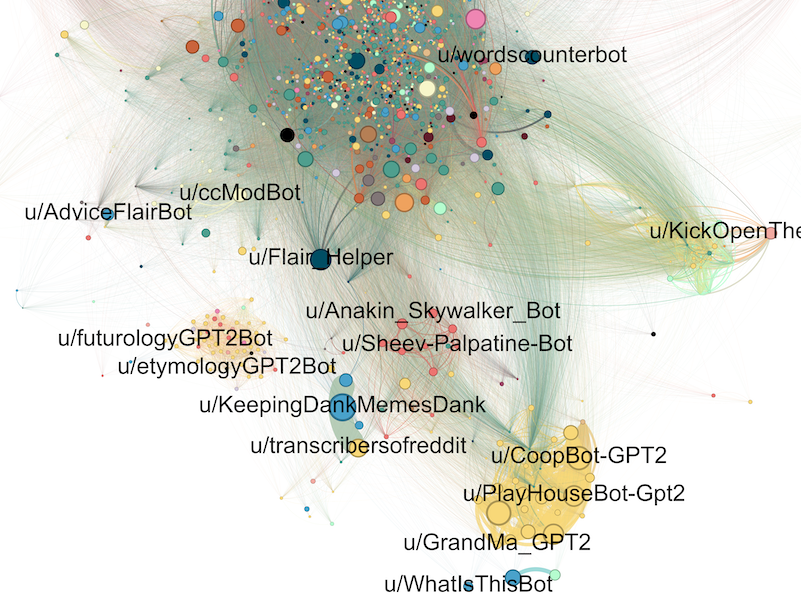
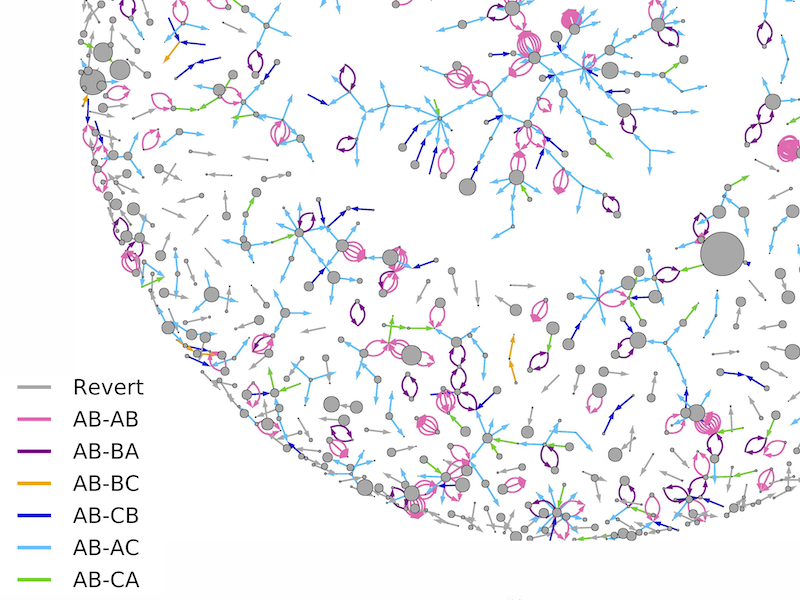
Clash of Bots

In recent years, there has been a huge increase in the number of bots online, varying from Web crawlers for search engines, to chatbots for online customer service, spambots on social media, and content-editing bots in online collaboration communities.

Read more.

Dynamics of Disagreement

Disagreement and conflict occur commonly in social life and considerably affect our well-being and productivity. Such negative interactions are rarely explicitly declared and recorded and this makes them hard for scientists to study.

Read more.

Mechanisms of Segregation

I collaborated with David Sumpter from Uppsala University and members of his Collective Behavior Group to do an experimental study on segregation mechanisms.

Read more.

Human-Machine Networks

In the current hyper-connected era, modern Information and Communication Technology systems form sophisticated networks where not only do people interact with other people, but also machines take an increasingly visible and participatory role.

Read more.

User-Contribution Communities

Every day, millions of people write online restaurant reviews, leave product ratings, provide answers to unknown users’ questions, or contribute lines of code to open-source software, all without any direct reward or recognition.

Read more.

The Contagion of Antisocial Behavior

Michael W. Macy and I replicated the study on the contagion of generosity for antisocial behavior. In the new online experiment, participants could anonymously take a portion of another participant’s payment.

Read more.

The Contagion of Generosity

Previous research has suggested that generosity may spread among individuals. However, the mechanisms through which such contagion occurs have remained unknown.

Read more.

Microfoundations of Inequality

If individuals are both inherently moderately heterogeneous as the ubiquitous “bell-shaped curve” suggests and inequity-averse as laboratory experiments on anonymous small-group interactions repeatedly show, why is inequality pervasive in society?

Read more.

Gossip

Allison Shaw, Roozbeh Daneshvar, and I developed a simple model for the effect of gossip spread on social network structure. We define gossip as information passed between two individuals A and B about a third individual C which affects the strengths of all three relationships: it strengthens A-B and weakens both B-C and A-C.

Read more.

Reciprocity

Asymmetric relations such as lending money, doing favors and giving advice form the basis of mutual aid and cooperation in human societies. However, they also provide a mechanism for the emergence of inequalities and hierarchies. Reciprocal behavior at the dyadic and network levels can prevent the aggregation of unequal exchange into unfair macro-level outcomes.

Read more.

Coevolution of Behavior and Networks

Social structure is both a consequence and a determinant of human behavior. In order to shed light on the problem of the emergence and maintenance of social order, one of the central underlying quests in social science, we need to understand how behavior and structure coevolve.

Read more.

Get in touch

Milena is available for press commentary and guest speaker slots.